




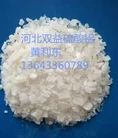
Iron-free aluminum sulfate and ordinary aluminum sulfate are two commonly used coagulants, mainly used in water treatment and sewage treatment. There are some differences between the two in terms of chemical properties, mechanism of action, and effects of use.
Concept
Iron-free aluminum sulfate
Iron-free aluminum sulfate, also known as iron-free aluminum oxide or polyaluminate, is a polymer coagulant without iron content. Its main component is Al2(SO4)3·nH2O, where n is usually 14-16. Iron-free aluminum sulfate forms aluminum hydroxide colloidal precipitation in water, which can effectively remove suspended particles and colloidal substances in water.
Ordinary aluminum sulfate
Ordinary aluminum sulfate, also known as iron-containing aluminum sulfate, aluminum sulfate, etc., is an iron-containing coagulant. Its main component is Al2(SO4)3·xH2O, where x is usually 16-18. Ordinary aluminum sulfate forms iron hydroxide colloid precipitation in water, which can effectively remove suspended particles, colloidal substances, and organic substances in the water.
Features
There are the following differences in characteristics between iron-free aluminum sulfate and ordinary aluminum sulfate:
1. Chemical properties
Iron-free aluminum sulfate does not contain iron elements, so it has less impact on water, does not affect the color and smell of water, and has better stability. The aluminum hydroxide colloidal precipitation formed in water is also more stable. In contrast, ordinary aluminum sulfate contains iron, so when it acts in water, it promotes the decomposition reaction of organic matter, resulting in changes in the color and odor of the water.
2. Mechanism of action
The main function of iron-free aluminum sulfate is to adsorb fine particles in water that are difficult to precipitate and aggregate them into larger particles so that they can be precipitated. In contrast, ordinary aluminum sulfate, in addition to adsorption, also has oxidizing properties and can oxidize organic matter in the water into carbon dioxide and water.
3. Effect of use
Because the reaction speed of iron-free aluminum sulfate is fast, it can quickly remove particles and colloidal substances in the water. It can also remove carbonates in the water without adding other chemicals. In comparison, ordinary aluminum sulfate requires a certain reaction time, and its effect in removing particles and colloidal substances is not as good as iron-free aluminum sulfate. However, the oxidizing property of ordinary aluminum sulfate is stronger than that of iron-free aluminum sulfate, so the removal effect of organic matter is more obvious.
Application
1. Application of iron-free aluminum sulfate
Iron-free aluminum sulfate is widely used in urban water supply, industrial sewage, rural drinking water, swimming pools, and other fields. It can effectively remove particles and colloidal substances in water, reduce turbidity in water, and also remove carbonates and heavy metal ions in water, thereby improving water quality.
2. Application of ordinary aluminum sulfate
Ordinary aluminum sulfate is mainly used in industrial wastewater treatment, sewage treatment, papermaking, petrochemical, and other fields. It has strong oxidizing properties and can effectively remove impurities such as organic matter and color from water. However, because it contains iron, it can easily cause pollution in these areas, and its use should be minimized.
In short, both iron-free aluminum sulfate and ordinary aluminum sulfate are very important coagulants, which have certain characteristics and application scenarios. Choosing the appropriate coagulant can effectively improve the quality and treatment effect of water, which is of great significance for water treatment and sewage treatment work.