




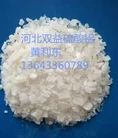
Aluminum sulfate is a white orthorhombic crystalline powder with a density of 1.69 g/ml at 25°C. In the paper industry, it is used as a precipitant for rosin and wax emulsions, and as a flocculant in water treatment. It also serves as an internal retention agent in foam fire extinguishers, and is used to manufacture alum, aluminum and white raw materials, oil decolorizers, deodorizers, and raw materials for certain pharmaceuticals, among others. It can also be used to produce artificial gems and high-grade ammonium alum.
Aluminum sulfate can be prepared by the pressurized reaction of bauxite with sulfuric acid, or by decomposing alunite, kaolin, and raw materials containing aluminum oxide and silicon with sulfuric acid. It can also be synthesized by adding aluminum hydroxide (Al(OH)₃) to sulfuric acid (H₂SO₄).
Aluminum sulfate appears as white, lustrous crystals, granules, or powder, and is stable in air. At 86.5°C, it loses part of its crystal water, and at 250°C, it loses all crystal water. When heated, it expands violently and becomes spongy. Heating to 770°C initiates decomposition into aluminum oxide, sulfur trioxide, sulfur dioxide, and water vapor. It is soluble in water, acids, and alkalis, but insoluble in ethanol. Its aqueous solution is acidic, forming aluminum hydroxide upon hydrolysis. Prolonged boiling of the aqueous solution produces basic aluminum sulfate.
Industrial products are grayish-white flakes, granules, or blocks, with low iron salts giving a light green color and oxidized low iron salts causing a yellowish surface. The crude product is a grayish-white porous material with a fine crystalline structure. It is non-toxic, but dust may irritate the eyes.
Aluminum sulfate is a widely used industrial reagent, often confused with alum. It is commonly used as a flocculant for purifying drinking water and in wastewater treatment facilities. In the paper industry, it serves as a precipitant for rosin and wax emulsions to enhance the water resistance and impermeability of paper. Additionally, it finds applications in cosmetics, fire protection, the fuel industry, etc. In cosmetics, it acts as a raw material (astringent) for antiperspirant products. In fire extinguishing, it combines with baking soda and foaming agents as a foam fire extinguishing agent. In the fuel industry, it functions as a precipitant for producing chrome yellow and lake dyes, while also serving as a fixing agent and filler.